The full story
Sandwich (夹涂棋, “sandwich and paint out”) is a folk pen-and-paper game. It is played entirely with two pens on squares of a grid: a mark that traps enemy marks between itself and one of your own, along a straight line, crosses them out for good — and a cell crossed out so much as once can never be used again, by either side.
The board
Rule a square and divide it into cells: 7×7 is the usual board, 9×9 for a longer game. Marks go in the middle of cells, not on the crossings. Our sheets print the grid with the columns lettered A–G (A–I on the big board) and the rows numbered, so players can say where they played.
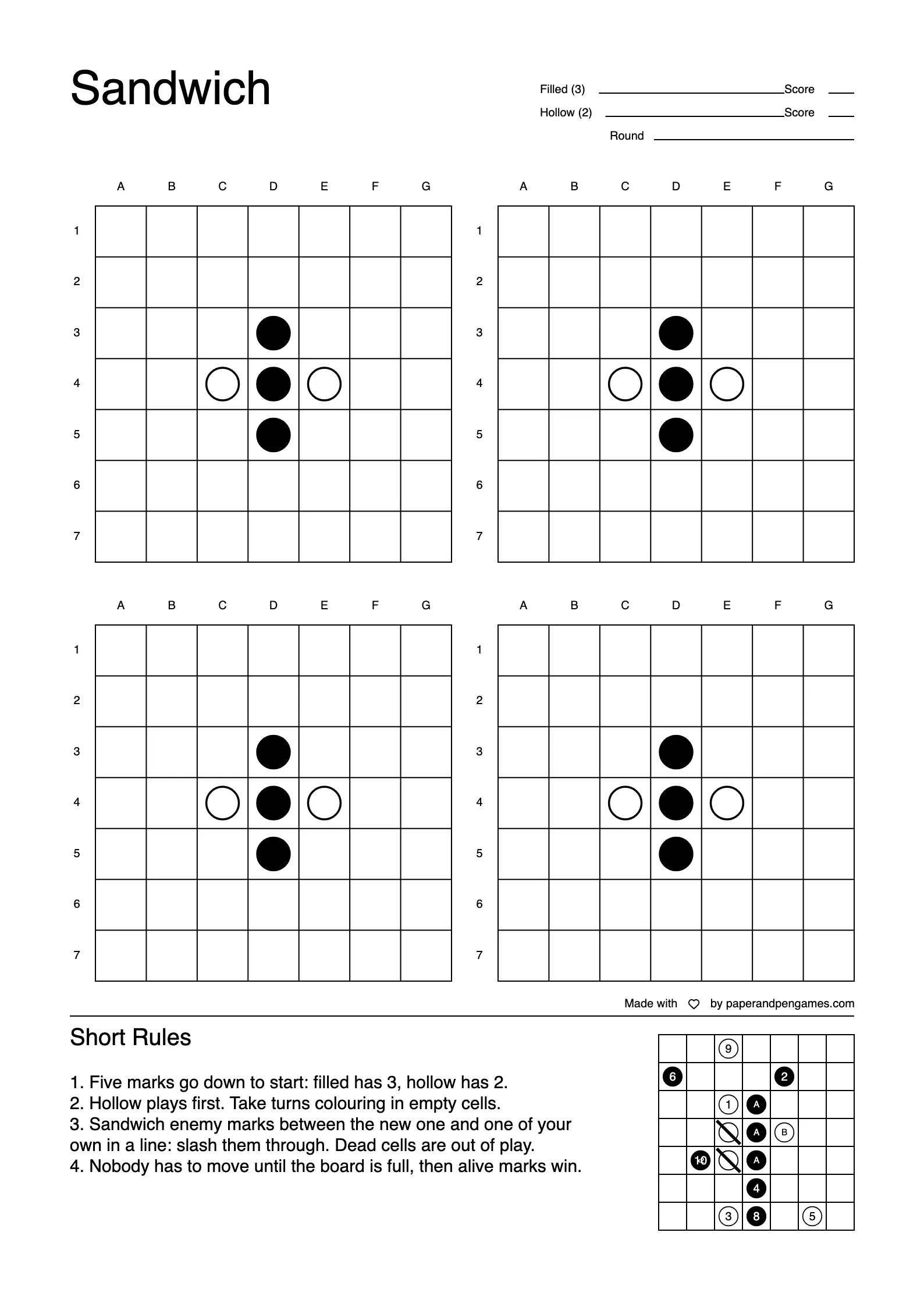
Each sheet carries four boards. A round fills the whole board, so that is a whole evening’s play — and a numbered example in the corner beside the short rules shows how the first ten moves of a game go.
Short rules
- Five marks start the game: one side draws 3 filled (side A), the other 2 hollow (side B), in the pattern shown.
- Side B plays first. Players take turns colouring in one empty cell with their own mark.
- If your new mark sandwiches enemy marks between itself and one of your own marks in a line, cross those enemy marks out. They are dead.
- Dead cells are never played in again. Carry on until every cell is filled or dead; the side with more live marks wins.
Complete rules
Setting up
Draw the grid. In the middle, draw a cross of five marks: put your own mark on the centre cell and on the cells immediately above and below it. Your opponent draws their marks on the cells immediately left and right of the centre. It is the opening our sheets print — three marks for one side, two for the other, with neither side holding a straight line already.
The side with two marks moves first. That is not a mistake: the side with three marks keeps the centre, and the side with two gets the first move to make up for it.
Making a move
A move is one new mark of your own colour in an empty cell that is neither occupied nor dead. Place it anywhere you like on the board; unlike some board games, a mark does not have to touch anything.
The sandwich
After you place your mark, look along the eight lines through that cell: the row, the column and the two long diagonals, in both directions. If along one of those lines you find a run of enemy marks lying between your new mark and one of your own marks, with nothing in between, that whole run is trapped. Draw a slash through each trapped mark: they are dead, and they no longer count for anybody. A single enemy mark trapped like this is killed; so is a run of two, three or more.
Both ends of the run must be live marks of your own: dead cells and empty cells in between break the sandwich, so a run that is not hard against your other mark is safe.
Two kills at once
The same move can work along several lines at the same time, and each one is applied. The classic strike is a mark that closes a row and a diagonal together, taking two enemy marks in two completely different parts of the board. Our numbered example ends on exactly that move: look at the discs on the crossed-out marks in the corner figure, and the number next to them is the move that killed them.
Dead cells
Once a mark is crossed out, the cell underneath is out of play for the rest of the game. Nobody may play on it. That is what makes a single capture so much more than a one-point swing: the hole it leaves can never be filled, so it also blocks lines that would otherwise run through it.
The end of the game
The game ends when every cell of the board is either filled with a live mark or crossed out. That leaves only the starting marks, the moves and the dead, so the two players together can fill a 7×7 board in 44 moves, 22 each.
Count the live marks: the side with more of them wins. On the 7×7 board a typical close game finishes around 11 to 9 to the player who got to move last — but count, do not guess.
Playing well
- Every move is a threat. Because dead cells come back never, a capture is worth far more than its one mark.
- Count the open ends. The middle cross has five marks and four free cells beside it; whoever fills a cell that completes a sandwich scores first.
- Keep your marks out of straight lines. A pair of your marks in a row is a promise to your opponent that they can play one cell beyond either one, and take the pair.
- Play the diagonals. Most players watch the rows and columns. Our example is won by a diagonal, and the cross’s own diagonal is the longest line on the board.
- A dead cell is a wall. It breaks any sandwich that would run through it, so a kill in the middle of a row is usually better than a kill at its end.
Variations
- 9×9 board. 81 cells, a much longer game, and the same five-mark opening. Our sheet option prints it.
- Openings. Rotating the starting cross by 45°, or putting the fifth mark on a diagonal instead of the centre, makes a noticeably different game out of the start.
- Fill and count. For younger players, ignore the “dead cells stay dead” rule for one or two games; they can be added once the sandwich itself is under control.