The full story
Shoreline (岸棋, “shore chess”) is a two-player placement game recorded in Chinese game-book collections of folk board games. Everything happens from one edge of the board, called the shore: stones walk inwards from there, a line of exactly three scores a point, and a line of four scores nothing. That last rule turns a familiar three-in-a-row game into one where you are scoring your own lines while quietly steering your opponent into a line that is one stone too long.
Board Setup
The board is 4×4 squares read as 5×5 points, and one edge is the shore. Each player has twelve stones, so the game ends with exactly one point left empty. Our sheet prints the lattice with a dot on every point, labels the columns A–E and the rows 1–5 (row 1 is the shore row), and hatches the water below the shore line.
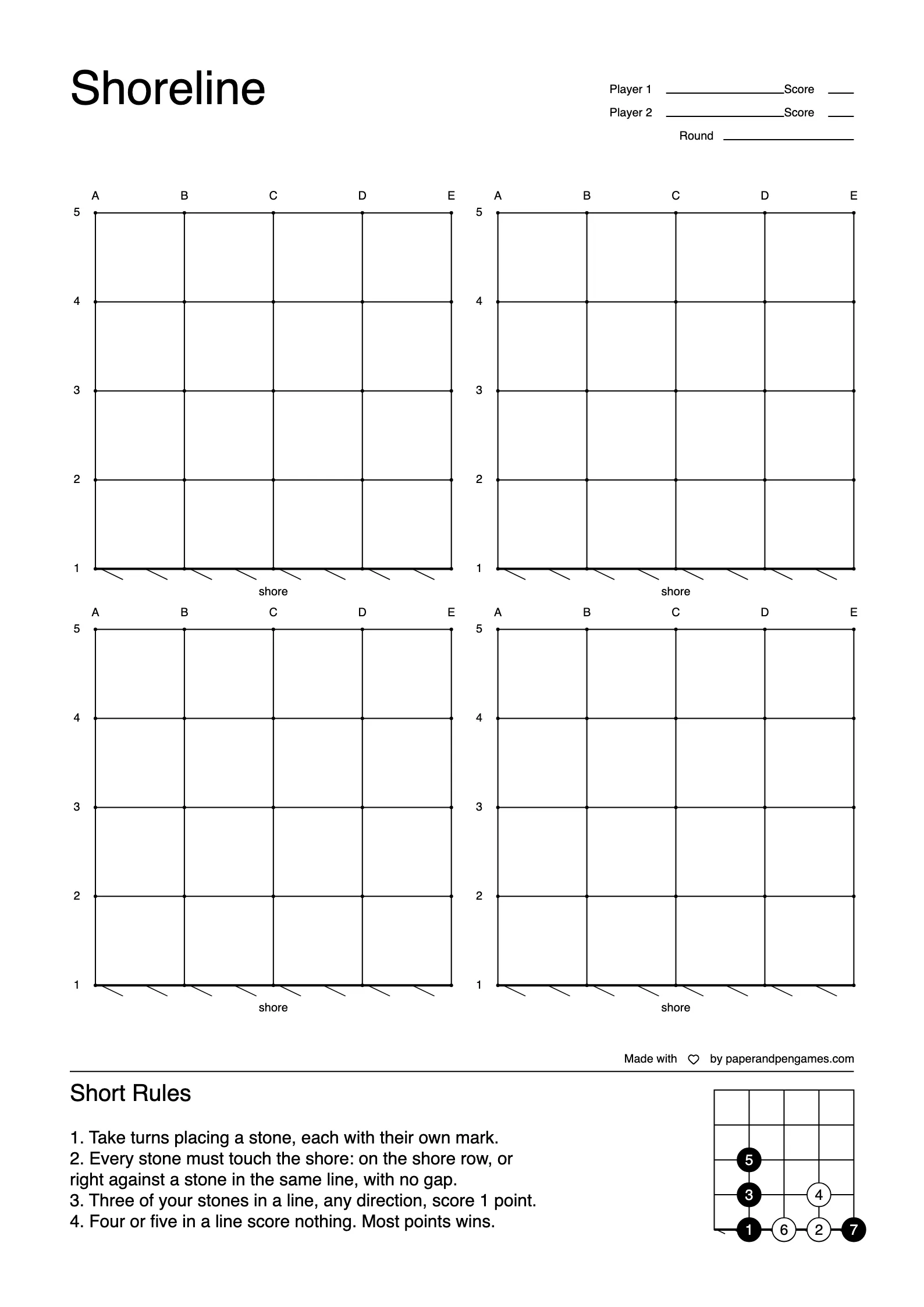
Short Rules
- Take turns placing a stone on an empty point; each player uses their own mark.
- Every stone must touch the shore: place it on the shore row, or right against a stone in the same line, with no gap.
- Three of your stones in a line, any direction, score 1 point.
- Four or five in a line score nothing. Most points wins.
Complete Rules
Placing stones
The board starts empty. Players take turns placing one stone, and every stone must be connected to the shore. There are two ways to do that:
- Play on any free point of the shore row.
- Play in any of the five columns that run away from the shore, directly against the highest stone already in that column. Nothing may be skipped, so each column fills up from the shore outwards.
Once a stone is on the board it never moves. Only the empty points of a column above its highest stone are available.
Scoring
When all stones are placed, every player counts their lines of exactly three stones. A line may run across, down or diagonally. A line of three scores 1 point; a line of four or five scores nothing at all — the stones in it earn no point, even though they contain two or three lots of three. This is the whole character of the game: a fourth stone in a good line destroys the point you had.
The player with more points wins the round; equal scores are a draw.
The end of the game
Twenty-four stones fill twenty-four of the twenty-five points. The last placement ends the game, and the single empty point is simply left blank. Count the lines, agree the score, and play again — a round takes a few minutes.
Playing well
- Build your three in a column you control, and finish it before the other side can block the third stone.
- Watch your opponent’s pairs. A pair of stones in a column is a threat; the point above it is both their scoring point and a trap you can close with your own stone.
- Diagonal lines are easy to forget, in both directions.
- Denying a point is often worth more than adding a stone, because the fourth stone in a line can wipe out a point that is already there.
Variations
Every sheet carries four boards, so one print job covers a whole evening: play them in order and add up the scores. Younger players can ignore the four-in-a-line rule for the first few games and simply play “three in a row scores”; the scoring twist can be added once the shore rule is second nature.