The full story
Tetrominoes (四格棋) is an elegant, pure pen-and-paper territory game for two players. With just a grid paper and two different pens, players take turns colouring four connected squares — using the seven classic single-sided tetromino shapes from Tetris. Pieces can be turned and flipped freely, but blocks may never overlap. As the board fills up, the first player who has nowhere left to fit a piece loses.
The Board
A square grid divided into cells: 9×9 (81 cells) is the classic board from traditional game books, but you can also choose 8×8 for a quicker match or 10×10 for a longer duel. Marks go inside the cells, not on the intersections. Our sheets label the columns with letters and the rows with numbers so moves can be recorded and called out easily.
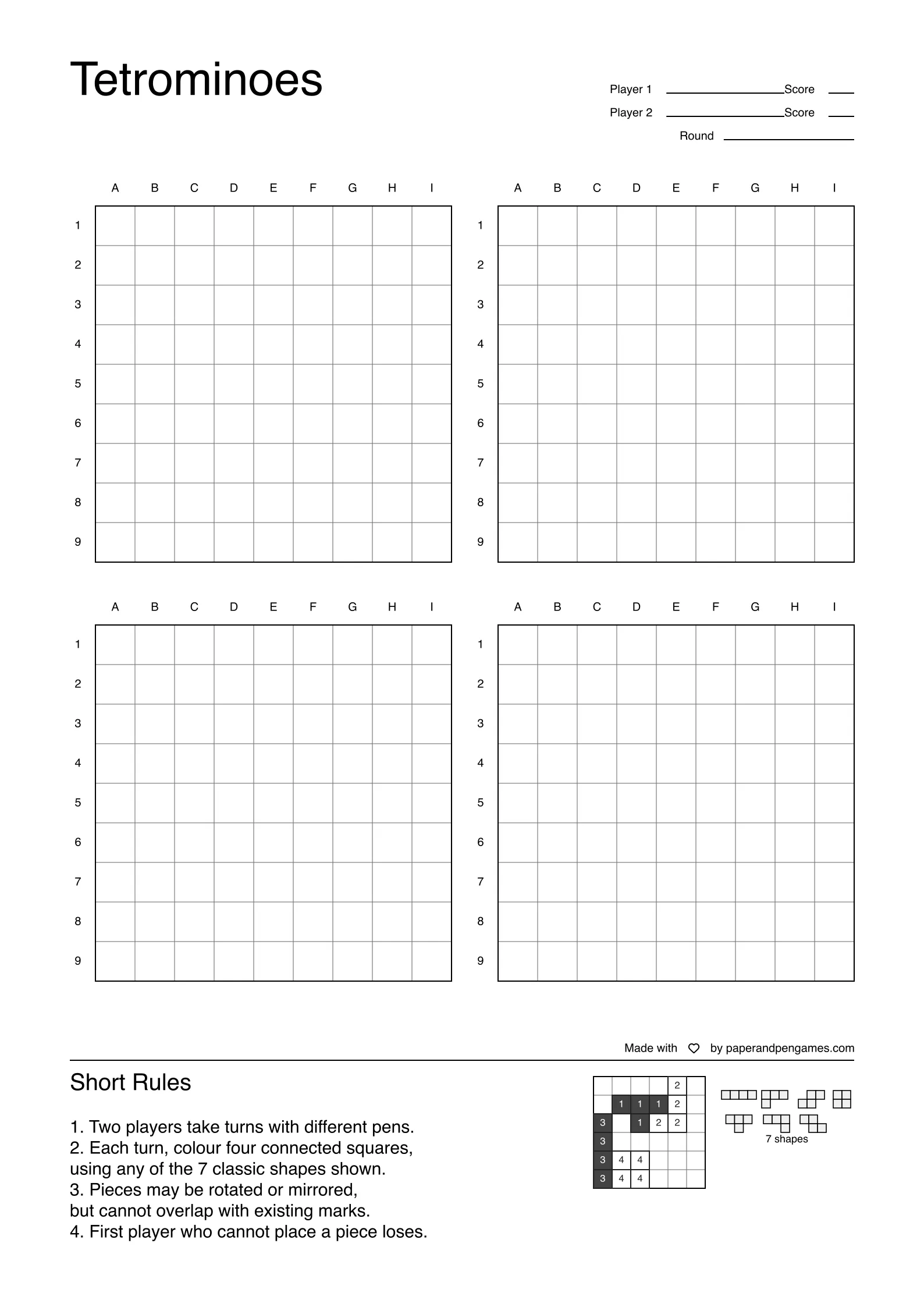
Each sheet carries four full boards. A typical game takes 12 to 16 turns to decide, so one printed page offers plenty of play. In the bottom right corner, a reference panel illustrates the seven single-sided shapes (straight, corner, step, square, and T) alongside a numbered four-step opening example.
Short Rules
- Start with an empty board. Two players take turns with different coloured pens (or distinct marks).
- Each turn, shade four connected squares using any of the 7 classic tetromino shapes.
- Pieces may be rotated or reflected in any orientation, but cannot overlap existing marks.
- The first player unable to fit a valid four-square piece on the board loses.
Full Rules
Setup
You need a printed sheet and two pens of different colours (e.g., blue and red, or black and pencil). If only one pen is available, one player can fill the cells solid while the other shades them with diagonal hatching or cross-marks. The game starts with a completely empty board. The first player takes the opening turn.
Playing a Turn: Shading Four Squares
Players take turns placing one piece. On your turn, you must colour in exactly four connected squares (orthogonally connected along their edges; corners touching diagonally do not count).
The four connected squares must match one of the seven standard single-sided tetromino configurations:
- Straight (I): 4 squares in a line (1×4).
- Corner / L-shape (L & J): a run of three squares with one square attached to the end (symmetric pair).
- Step / Skew (S & Z): two runs of two squares offset like steps (symmetric pair).
- T-shape (T): a run of three squares with one square centred on its side.
- Square (O): a 2×2 block of four squares.
You may choose any of the 7 shapes on any turn. You are free to rotate the piece by 90°, 180°, or 270°, and reflect (mirror) it however fits your plan.
Placement Constraints
- You must shade exactly 4 squares per turn — no more, no less.
- All 4 squares must be empty. A piece may never overlap or cut into any cell that was previously shaded by either player.
- Once shaded, a cell remains permanently occupied for the rest of the game.
Ending and Winning
As pieces accumulate, the remaining open space fractures into smaller pockets and narrow alleys.
When it is your turn, if there is no combination of four connected empty cells anywhere on the board that can legally receive any of the 7 tetromino shapes, the game ends immediately. You lose, and your opponent wins.
This win/loss condition mirrors impartial mathematical games like Nim and Cram — under the standard normal play convention, the last player to make a legal move wins.
Tactics and Strategy
- Creating dead pockets. If your move isolates an area of 1, 2, or 3 cells, you know your opponent can never play there. That dead space is permanently lost to both players, effectively shrinking the board for your rival.
- The square (2×2) as a bulkhead. Because the O-tetromino is two cells wide and two cells tall, dropping one near the centre or across a bottleneck can sever an entire corridor, preventing long shapes like the I-piece or L-piece from traversing between zones.
- Keep multiple fronts open. Avoid concentrating your moves exclusively in one corner. If your opponent walls off that quadrant, you could find yourself out of options. Maintain footholds across separated sectors of the board.
- Exploit irregular shapes in the endgame. Straight lines and 2×2 squares are easy to see and block, but the T-shape and the step-shapes (S/Z) can snake into tricky indentations that your opponent thought were unusable.
- Count the parity. A 9×9 board has 81 cells. Since each tetromino consumes 4 cells, the theoretical maximum number of moves is 20 (80 cells), always leaving at least 1 orphan cell. In practical games, dead pockets mean games conclude in 12–16 moves. Tracking which player has the parity advantage can guide your mid-game timing.
Choosing a Board Size
- 8×8: 64 cells (exactly 16 pieces if packed tightly). A quick, tight game that is great for young children or a swift round.
- 9×9: 81 cells. The classic size from paper-and-pen gaming tradition. Because 81 is not divisible by 4, leftover cells are guaranteed, making the territorial struggle especially sharp.
- 10×10: 100 cells. A spacious board allowing deep strategic maneuvering across multiple distinct sectors before boundaries meet.