The full story
Branches (树枝棋, “branch chess”) is a pen-and-paper game. Each player uses one pen, and both share a sheet of squared paper. The board is a square of cells, and every edge between two neighbouring intersections is a place to draw. Our sheet offers 6×6, the classic 8×8, and 10×10; pick the size for the length of game you want. Each side starts from two points it has circled, then grows a tree: three joined edges per turn, straight or bent. An edge can never be drawn twice, and the first player who runs out of legal branches loses.
Board Setup
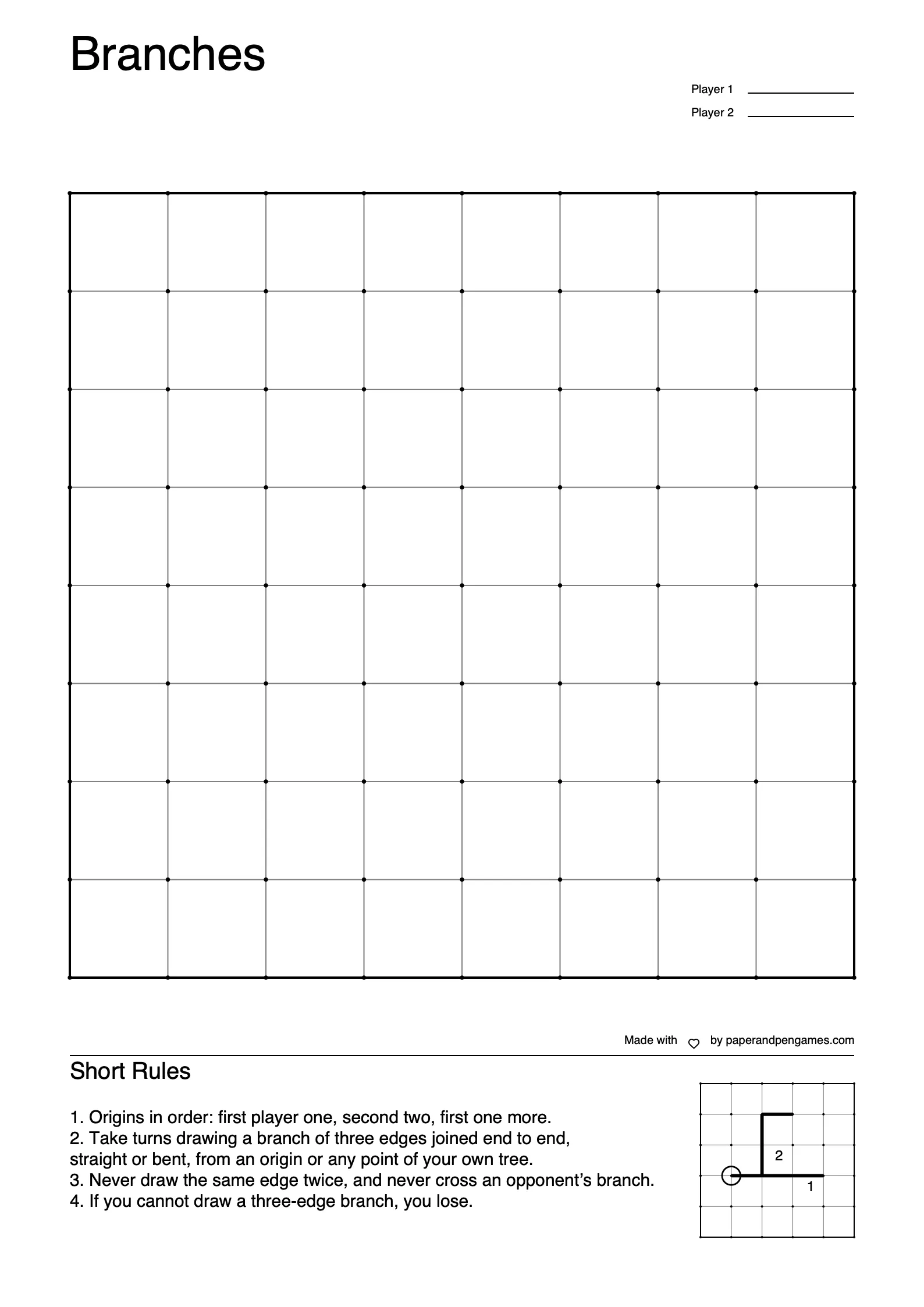
Choose a board: 6×6 cells for a quick game, 8×8 for the classic, or 10×10 for a long one. The game is played on the lines, not in the cells: an 8×8 board has 64 cells, 81 intersections and 144 edges, and every edge is a possible stroke. Our sheet prints a dot on each intersection so origins are easy to circle.
| Board | Edges | Branches at most |
|---|---|---|
| 6×6 | 84 | 28 |
| 8×8 | 144 | 48 |
| 10×10 | 220 | 73 |
Those are upper bounds: an edge is only usable while it can still be reached from a player’s tree, so real games end well before the last edge is drawn. The bigger the board, the more room both trees have to grow before they run into each other.
Each player uses a different coloured pen. Before the first branch, the players choose their starting points, called origins. The first player circles one intersection, the second player circles two, and the first player circles one more — four origins in total, two per player. Choosing in the order A–B–B–A balances the first player’s advantage. An origin may be anywhere on the board, including on the border.
Short Rules
- Circle starting points in this order: first player one, second player two, then the first player one more.
- Take turns drawing a branch of three edges joined end to end, straight or bent.
- Start from an origin, then from any point of your own tree.
- Never reuse an edge, and never cross an opponent’s branch.
- If you cannot draw a branch, you lose.
Complete Rules
Choosing origins
The first player circles one intersection, the second player circles two, then the first player circles one more. Nobody may choose the same point twice. The origin does not have to be near the middle, and it does not have to be far from the opponent: an origin on the edge is legal, though it has fewer directions to grow in.
The player who chose second draws the first branch.
Drawing a branch
A turn is one branch: exactly three edges joined end to end. The three edges must share their end points, so the branch is a path of four points. It may be straight, or bent at one or two of its points — an L, a step, a U-turn, a zigzag. It may not spread out into a Y or a fork, and it may not include an edge that has already been drawn.
The first branch of the game must begin at one of your origins. After that, a branch may begin at any point of your own tree: an origin, the far end of an earlier branch, or any joint along it. Every new branch therefore leaves new legal starting points behind, which is what makes the tree grow.
Sharing the board
An edge belongs to the first player who draws it and is then closed to both players for the rest of the game.
- Your new branch may touch your own earlier branches at points, and may cross them (making an X), as long as it does not reuse an edge.
- Your branch may touch an opponent’s branch at a point, so a T-junction or an L-junction between the two colours is fine.
- Your branch may never pass through an opponent’s branch. Treat a point where both colours would run through as an X as a crossing and leave it alone.
Because a branch cannot cross the other colour, a long line of your edges becomes a wall. The edge of the board is a wall too. Most of the game is about building walls that leave you room to grow and take room away from your opponent.
The end
If you cannot draw a legal three-edge branch, you lose. You may still have free edges on the board and still have a tree — the rule is only that no three-edge path is open to you. Check carefully before giving up: a three-edge branch may start anywhere on your own tree, not just at its newest end.
Strategy
- Count the free edges at your points. A point in the middle of the board has four edges; a point on the border has three; a corner has two. A tree that reaches a corner is easy to finish off.
- Grow towards open space. A branch that ends in the middle leaves more possibilities for the next turn than one that ends against the border or against the opponent’s colour.
- Make walls, not decorations. Since the other colour cannot cross your branch, a connected line of your edges can cut off part of the board. Draw walls that leave your own tree on the large side.
- Keep two doors open. Each turn uses one three-edge path, but leaves several new starting points. A good position has at least two independent places to play, so one blocked direction does not end the game.
- Watch the parity. Every branch uses three edges, so the number of edges still reachable from your tree matters. When the board gets tight, count before you draw.
Choosing a size
- 6×6 is the short game. It has 84 edges, so neither tree can grow for long before the board gets tight. Good for younger players, a waiting room, or a quick rematch.
- 8×8 is the classic size. One game usually fills a sheet, and the middle of the board is still open when the first walls go up.
- 10×10 is the long, tactical game. With 220 edges there is room for several separate fights, and counting free edges starts to matter.
For very young children, use 6×6 and agree to draw two-edge branches. For a longer club game, use 10×10 and four-edge branches. Both are house rules; the standard three-edge branch is the main game.