The full story
Ragged Lanes is a counting game for two, played straight on the sheet with nothing but two pencils. Seven lanes stand side by side, every one a different length and each hanging a little higher or lower than its neighbours. Each lane carries a solid mark at one end and a hollow mark at the other; players take turns filling in the empty cells between them, and whoever fills the last one wins.
The board
Draw seven lanes side by side, every one a different length: pick seven lengths between four and twelve cells and shuffle them. Hang each lane half of its extra length above the middle and half below — a long lane pokes out at both ends, a short one sits back at both — and let the row of lanes wander up and down a cell or two as it goes. That makes the board ragged at both ends by about the same amount, so neither player is handed the tidy edge, and it is where the name comes from: 参差 means ragged, irregular.
One side owns the bottom ends, with a solid mark in the last cell of every lane. The other side owns the top ends, with a hollow mark in the first cell of every lane. Those fourteen marks are printed on our sheets, together with the lane numbers 1 to 7 and four boards to a page. The seven lengths are dealt at random out of four to twelve, so successive sheets hold different heaps and no two boards start the same.
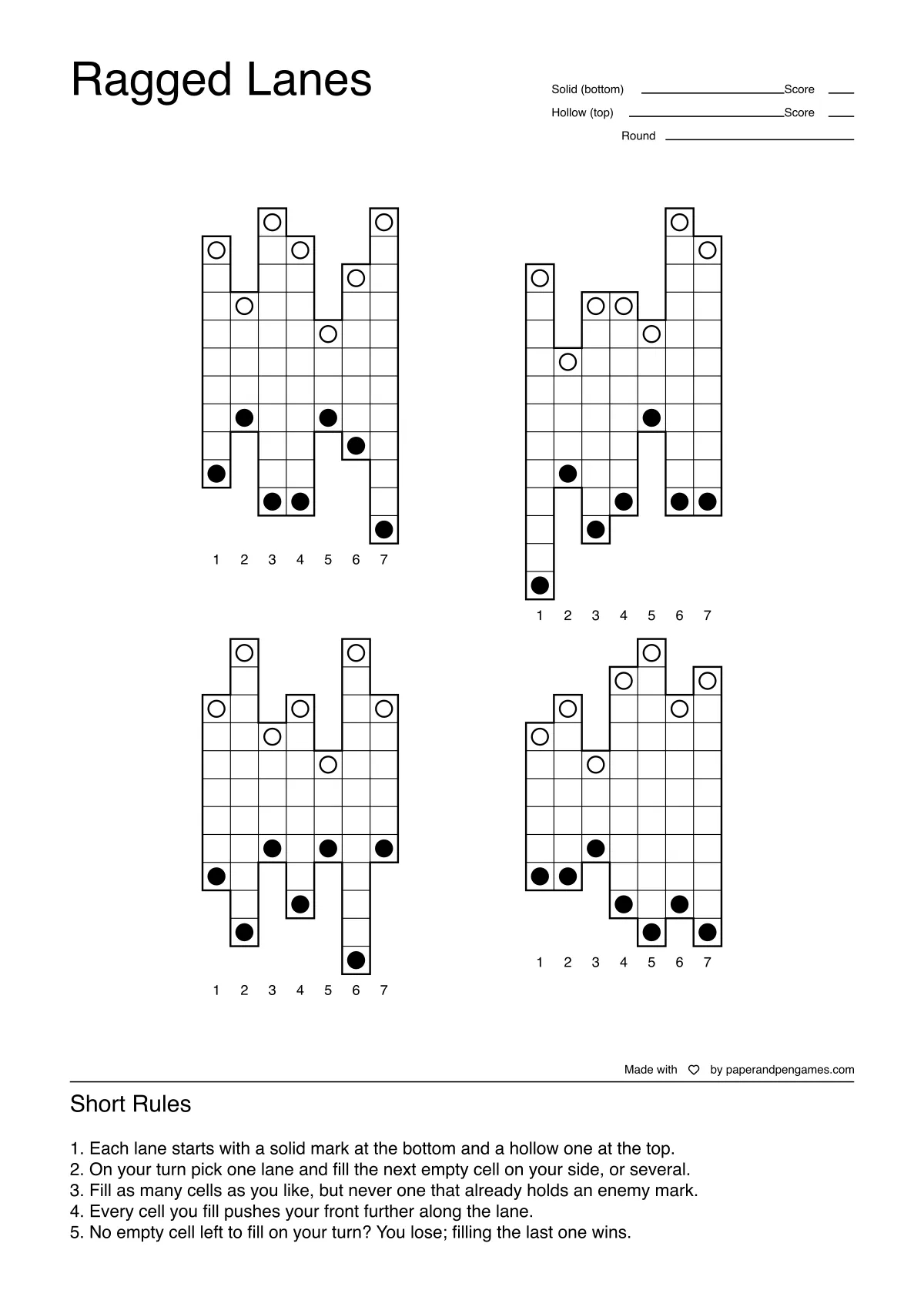
Short rules
- Each lane starts with a solid mark at the bottom and a hollow one at the top.
- On your turn pick one lane and fill the next empty cell on your side, or several.
- Fill as many cells as you like, but never one that already holds an enemy mark.
- Every cell you fill pushes your front further along the lane.
- No empty cell left to fill on your turn? You lose; filling the last one wins.
Complete rules
Setting up
There is nothing to set up beyond the board itself: seven staggered lanes, one solid mark at the bottom of each, one hollow mark at the top. No pieces to move, nothing to erase — the marks on the paper are the whole position, and they only ever move inwards.
Filling in
A turn fills empty cells in one lane, and only that lane. Start at the cell next to your own run — above it for the solid side, below it for the hollow side — and fill in one cell, or as many in a row as you like. Filled cells join your run, so its front moves along the lane.
You may never fill a cell that already holds an enemy mark. Because the runs grow towards each other, the two fronts keep the order they started in, and the empty cells left between them are all that is still in play. A larger run is always stronger: taking four cells in one turn can be worth more than four separate turns, because it removes choices from both sides at once.
The end
Play until no empty cell is left in any lane. Both sides face the same empty cells, so a player runs out of room at exactly the moment the other does: the last cell filled ends the game, and the player who filled it wins. Count the empty cells as you go, and you will see it coming several turns early.
The counting behind it
The game is Nim in disguise. Count the empty cells between the two runs of a lane and write the number down: that lane is a heap of that many stones, and a turn takes any number from one heap, in that lane only. Nim has a complete answer, so this one does too.
Write every heap size in binary, one under another, and add the columns the way Nim players do: no carrying, an odd number of 1s gives 1 and an even number gives 0. That answer is the nim-sum. If the nim-sum is not zero, the player to move can always bring it back to zero; if it is zero, every move must break it. So:
- Nim-sum zero: the player to move loses with perfect play.
- Nim-sum not zero: the player to move wins, by making it zero.
To find the winning move, pick a heap and shrink it to heap XOR nim-sum; that is always smaller than the heap you picked, and it zeroes the nim-sum. Every later turn, do the same again.
A worked example. Suppose the gaps read 2, 4, 3, 5, 6, 7 and 9. The nim-sum is 8. The 9 is the heap that shrinks: 9 XOR 8 = 1, so fill eight cells in that lane and leave a gap of 1. The gaps are now 2, 4, 3, 5, 6, 7, 1 and the nim-sum is zero. Whatever your opponent fills next, they must break it, and you put it back.
Two things are worth knowing even without the arithmetic:
- Count before you sit down. Some boards are won by the first player, some by the second. Work out who has the winning plan and let that person go first.
- The last cell is the game. However the middle goes, whoever fills the final empty cell takes the round — so keep one eye on how many empty cells are left overall.
Variations
- Smaller boards. Three or four lanes make a quick round whose nim-sum you can work out in your head; seven lanes is the full table.
- Equal lanes. Give every lane the same number of cells and the game gains a memory: with an even number of lanes, the second player can copy every move in a matching lane.
- Do not fill the last cell. Play misère: the player who fills the final empty cell loses. The counting changes near the end, and it makes a good second lesson once normal play is clear.
- Longer lanes. Pick the seven lengths higher up the range — eight to fourteen, say — and the same board plays longer. Our sheets deal seven lengths between four and twelve at random, so a fresh sheet is a fresh position. Tearing one in half gives two games to play side by side.